

Security Camera Blind Spots Every Home Has
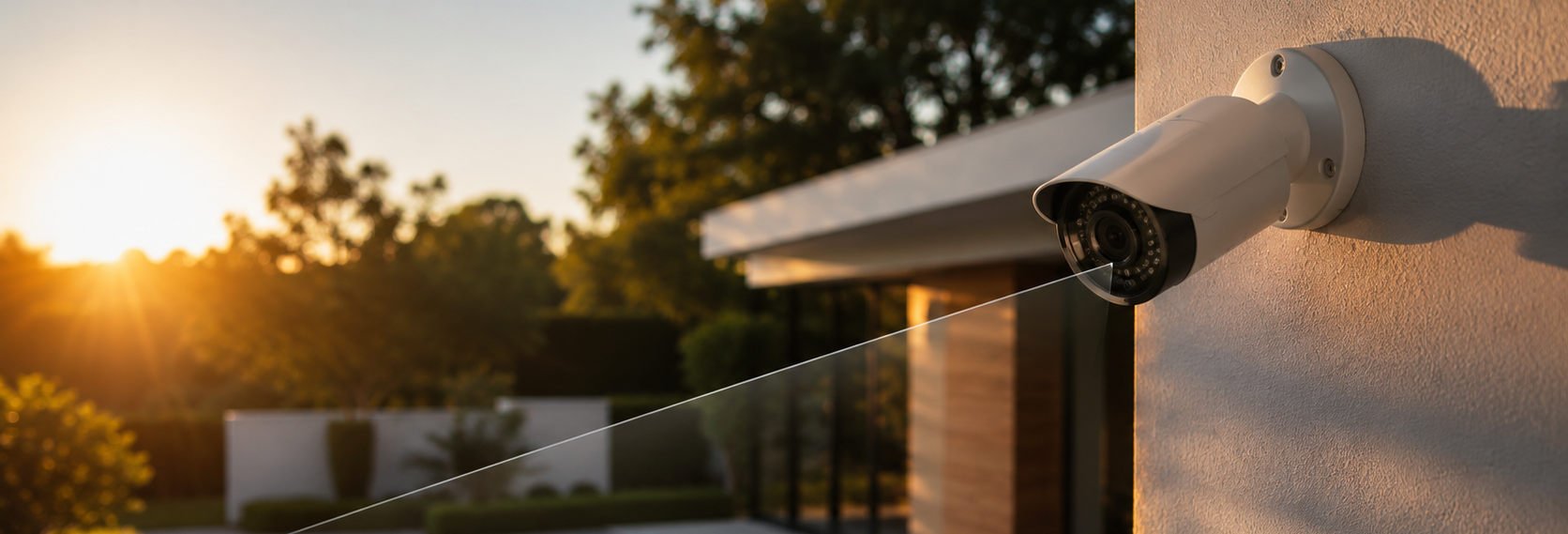
A security camera offers a powerful sense of reassurance. You glance at the live feed, see your front door and driveway in crisp detail, and feel confident that your property is covered. Yet that confidence often rests on a dangerous assumption: that a camera protects everything, when in reality it only protects what it can actually see. The gaps between what you think your cameras capture and what they actually capture are known as blind spots, and nearly every home has them.
At Moore Protection, we have assessed hundreds of Los Angeles properties where homeowners believed their surveillance was complete, only to discover unmonitored paths leading straight to a back door or a side gate. These gaps are precisely where determined intruders look first. This guide walks through the most common security camera blind spots, the technical reasons they form, and the proven strategies our security professionals use to eliminate them.
What Is a Camera Blind Spot, and Why It Matters
A blind spot is any area within or around your property that falls outside the effective view of your cameras. It might be a literal gap where no camera points, or a subtler failure: an area technically within frame but rendered useless by glare, distance, darkness, or an obstruction. In both cases, the result is the same. Activity in that zone goes undocumented, and the protection you believed you had simply is not there.
The stakes are higher than many homeowners realize. Burglars rarely approach a house at random. They observe, they probe, and they identify the path of least resistance, a process often described as casing a property. A single uncovered angle, such as a shadowed side yard or a gate hidden behind a hedge, can become the exact route an intruder chooses precisely because it offers concealment. Understanding where these weaknesses form is the first step toward closing them. A thorough assessment of your home’s vulnerabilities should always account for camera coverage gaps alongside doors, windows, and other entry points.
The Most Common Blind Spots Around a Home
While every property is unique, certain blind spots recur across residential surveillance setups. Recognizing these recurring patterns helps you evaluate your own coverage with a more critical eye.
Directly Beneath the Camera
One of the most overlooked gaps sits right below the camera itself. Most fixed cameras are mounted high on a wall and angled outward to capture an approach, which leaves a cone of dead space directly underneath, sometimes called the cone of darkness. An intruder who reaches the wall can press against it, manipulate the mount, or move along the base of the house entirely unseen. This is why a single camera over a door rarely provides the complete protection homeowners assume it does.
Entry Points Hidden by Landscaping
Mature trees, tall shrubs, and decorative hedges enhance a property’s beauty, but they are also among the leading causes of camera blind spots. Foliage that looked manageable at installation can grow over a season to obscure a gate, a ground-floor window, or a walkway. Overgrown landscaping does double damage: it blocks camera sightlines while simultaneously providing the concealment an intruder needs to work undetected. Regular trimming and thoughtful camera placement relative to plantings are essential to maintaining clear coverage.
Side Gates, Rear Yards, and Alley Access
Homeowners naturally prioritize the front of the house, where cameras are visible and act as a deterrent. As a result, side gates, rear yards, and alley-facing access points are frequently neglected. These are often the very areas a burglar prefers, shielded from street view and neighbors. A backyard sliding door or an unmonitored side passage can offer an intruder both privacy and time. Comprehensive perimeter security treats these secondary approaches with the same seriousness as the front entrance.
Garages, Driveways, and Vehicle Approaches
Attached garages represent a common point of entry, yet they are often poorly covered. A camera aimed at the garage door may capture a vehicle pulling in while missing the pedestrian door on the side or the space between parked cars where someone could crouch out of view. Long driveways introduce distance-related blind spots as well, where a subject far from the camera becomes too small to identify. Capturing a license plate or a face at the end of a driveway requires deliberate camera selection and positioning, not simply pointing a unit in the general direction.
Second-Story Windows and Roof Access
Most residential cameras are oriented to monitor ground-level activity, which leaves upper floors exposed. Trellises, fences, balconies, and adjacent structures can give an agile intruder a route to second-story windows or rooftop access points that no ground-facing camera will ever capture. For multi-level homes, and particularly for properties with accessible upper entry points, vertical coverage deserves the same attention as the ground floor. Knowing how burglars target a home makes the value of covering these less obvious approaches immediately clear.
Technical Causes Owners Overlook
Not every blind spot is a matter of where a camera points. Many gaps form because of technical limitations that are invisible until something is missed. Understanding these factors helps explain why a camera that seems perfectly positioned can still fail when it matters most.
Field of View and Lens Limitations
Every camera captures a specific field of view determined by its lens. A narrow-angle lens delivers detail at distance but covers a limited slice of the scene, while a wide-angle lens sees more but can distort edges and shrink distant subjects. Homeowners who assume a single camera covers an entire yard are often surprised to learn how much falls outside the frame. Matching lens characteristics to the area being protected is a core part of professional system design, and getting it wrong leaves predictable gaps at the margins of every view.
Mounting Height and Angle Mistakes
Proper component placement significantly impacts how well a system performs. A camera mounted too high captures the tops of heads rather than identifiable faces. One mounted too low is easily tampered with and offers a narrower useful range. An incorrect downward tilt can shorten the effective viewing distance dramatically, turning what should be broad coverage into a small patch of ground. These are the subtle positioning errors that frequently separate a do-it-yourself install from a professionally engineered one.
Glare, Backlighting, and Night-Vision Washout
Lighting creates some of the most deceptive blind spots because the camera appears to be working perfectly until conditions change. A unit aimed toward the rising or setting sun can be washed out by glare for hours each day. Strong backlighting turns a subject into an unidentifiable silhouette. At night, infrared illumination can reflect off nearby walls or wash out close objects while leaving the background dark. These lighting-driven gaps are easy to miss during a quick daytime check of the feed and demand testing across different times and conditions.
Wireless Signal Gaps and Connectivity Drops
A wireless camera positioned at the far edge of a property may sit beyond reliable signal range, causing dropped footage, lag, or offline periods that create intermittent blind spots in time rather than space. A camera that is recording one moment and disconnected the next provides unreliable protection. Strong, consistent connectivity is a prerequisite for dependable surveillance, which is why thoughtful network planning is part of designing any smart home security system rather than an afterthought.
How to Audit Your Own Coverage
You can begin identifying blind spots yourself with a methodical review. Start by pulling up the live feed from every camera and noting exactly what each one sees, and just as importantly, what it does not. Then walk your entire property perimeter slowly, watching the feeds as you move. Pause at gates, beneath windows, alongside the garage, and in the shadowed corners of the yard. Anywhere you can stand without appearing clearly on a screen is a blind spot.
Repeat this walk at different times of day, since glare, shadows, and night-vision performance change dramatically between morning, midday, and after dark. Look specifically for areas where one camera’s view should overlap with the next, because gaps between adjacent cameras are among the most common and most exploitable weaknesses. While a careful homeowner can spot many issues this way, there is a meaningful difference between a do-it-yourself and a professional approach, as trained eyes routinely catch subtle gaps that are easy to walk right past.
Strategies to Eliminate Blind Spots
Closing coverage gaps is rarely about simply adding more cameras. It is about deploying the right equipment in the right configuration so that each component reinforces the others. The following strategies form the backbone of a genuinely complete surveillance design.
Overlapping Fields of View
The single most effective principle in surveillance design is overlap. Each camera’s field of view should extend slightly into the next, creating a continuous chain of coverage with no seams. This overlap not only eliminates gaps but also provides redundancy: if one camera is obstructed, tampered with, or fails, an adjacent unit still captures the area. Properly overlapping coverage transforms a collection of individual cameras into a unified, gap-free system.
PTZ and Wide-Angle Cameras for Large Areas
Expansive properties present a challenge that fixed cameras alone struggle to meet. Pan-tilt-zoom cameras address this by covering wide areas with a single unit, sweeping across a yard, tilting to follow movement, and zooming in on detail when something warrants a closer look. A well-placed PTZ camera can dramatically reduce the number of fixed units needed for a large space while its automated patrol patterns maintain consistent coverage. Paired with wide-angle units at fixed approaches, this combination covers ground that would otherwise demand far more equipment.
Layering Cameras With Sensors and Lighting
Cameras become far more powerful when integrated with complementary security layers. Motion-activated floodlight cameras, for example, eliminate darkness-related blind spots by illuminating an area the instant movement is detected while capturing high-resolution video. Motion sensors can trigger nearby cameras to begin recording or prompt an alert, ensuring that even a brief appearance in a marginal zone does not go unnoticed. This layered, coordinated approach is a defining feature of modern home automation and integrated security, where each element amplifies the effectiveness of the others. Interior coverage matters too; pairing exterior cameras with indoor cameras ensures that if someone does breach the perimeter, they remain in view.
Where Professional Design Makes the Difference
A homeowner’s self-audit is a valuable starting point, but professional system design is what reliably closes the gaps that remain. Experienced security consultants conduct a thorough property assessment, evaluating architectural features, landscaping, lighting conditions, and likely threat paths to identify vulnerabilities an untrained eye tends to miss. They understand how lens selection, mounting geometry, and overlapping coverage interact, allowing them to place each camera where it delivers maximum benefit rather than relying on guesswork.
This expertise becomes even more valuable when surveillance is paired with active oversight. Professional monitoring transforms cameras from passive recorders into a responsive security solution, with trained professionals using video verification to distinguish genuine threats from false alarms and to dispatch help quickly when it is needed. A professionally designed home security system brings these elements together into coverage that is complete by design rather than by chance. For homeowners weighing where to invest, eliminating blind spots is consistently among the most impactful security upgrades available.
Frequently Asked Questions
How many cameras does an average home need?
There is no universal number, because coverage depends on a property’s size, layout, and entry points rather than a fixed count. A modest single-story home may be well protected with four to six well-positioned cameras, while a larger property with multiple access paths and outbuildings can require considerably more. The right figure comes from mapping every approach and vulnerability, not from a one-size-fits-all rule.
Can blind spots be fixed without buying new equipment?
Often, yes. Many blind spots stem from poor angles, incorrect mounting height, or overgrown landscaping rather than insufficient cameras. Repositioning an existing unit, adjusting its tilt, trimming foliage, or improving lighting can resolve a surprising number of gaps. Where genuine coverage is missing, however, adding a strategically chosen camera is the more effective solution.
Do more cameras always mean better security?
Not necessarily. A handful of cameras placed with overlapping coverage and correct angles will outperform a larger number installed haphazardly. Quantity without strategy simply creates more feeds to monitor while leaving the same gaps. Thoughtful placement, not sheer numbers, is what eliminates blind spots.
How often should I re-check my camera coverage?
A seasonal review is a sensible baseline, since landscaping growth, changing daylight, and shifting household routines can all introduce new gaps over time. It is also wise to re-audit after any property change, such as new construction, fresh plantings, or the addition of a fence or structure that could alter sightlines.
Eliminate Your Blind Spots With Moore Protection
Cameras are only as effective as the coverage they provide, and the gaps you cannot see are precisely the ones that matter most. At Moore Protection, our security professionals specialize in identifying and eliminating the blind spots that leave Los Angeles homes exposed. We assess each property’s unique characteristics, design surveillance systems with truly comprehensive coverage, and pair advanced camera technology with professional monitoring for protection you can rely on around the clock.
Contact Moore Protection today to schedule a professional security assessment. Our team will evaluate your current coverage, pinpoint every gap, and recommend a tailored solution that ensures nothing on your property goes unseen. Experience the peace of mind that comes from knowing your home is protected by a system designed to leave no blind spots behind.


