

Home Security During a Wildfire Evacuation
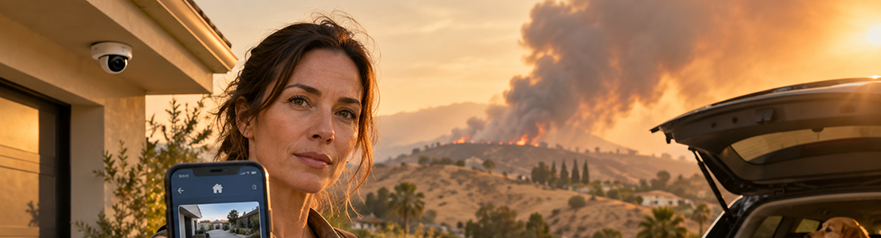
Wildfire season has always been part of life in Southern California, but January 2025 changed how Los Angeles homeowners think about it. When the Palisades and Eaton fires forced tens of thousands of residents from their homes, the danger didn’t end with the flames. Within days, law enforcement was making arrests inside evacuation zones for burglary, curfew violations, and even impersonating firefighters. At Moore Protection, we’ve spent more than two decades protecting homes across Los Angeles, including in the very neighborhoods those fires reached, and we’ve learned that an evacuation creates a security problem most homeowners never plan for. This guide explains how to protect your home during a wildfire evacuation: what to prepare before fire season, what to do in the final minutes before you leave, how to watch over your property from wherever you evacuate, and how to return home safely when the order lifts.
Why Evacuations Create a Security Problem
An evacuation does something no burglar could arrange on their own: it empties entire neighborhoods at once, often in the middle of the night, with almost no warning. Homeowners leave in a hurry, doors and gates are sometimes left unsecured, and normal neighborhood activity, the cars in driveways, the lights in windows, the neighbor walking a dog, disappears overnight. For the days or weeks that an evacuation order stays in effect, homes sit unoccupied in areas where residents themselves are barred from returning.
That combination attracts opportunists. Following the January 2025 fires, authorities reported 48 arrests for burglary, curfew violations, and related offenses within the first week, and the Los Angeles County Sheriff’s Department imposed an overnight curfew across evacuation areas to deter entry. Some of the people arrested had allegedly posed as firefighters to move through closed areas. California treats this conduct seriously: Penal Code 463 raises the penalties for burglary and theft committed during a declared emergency or under an evacuation order. But enforcement happens after the fact. Your security system is what protects your home while it’s happening.
In our experience, the homes that fare best during an evacuation aren’t necessarily the ones with the most equipment. They’re the ones whose owners prepared their systems for this exact scenario: a long, unplanned absence during which power, internet, and normal response channels may all be disrupted. That preparation begins well before the first red flag warning.
Before Fire Season: Preparing Your System
Know Your Zone and Your Alerts
The single most useful thing you can do before fire season has nothing to do with security equipment. Los Angeles County and the City of Los Angeles organize evacuations by numbered zones, and official evacuation orders and warnings are issued zone by zone through Genasys Protect. Look up your zone now, write it down, and make sure everyone in your household knows it. During a fast-moving fire, the difference between hearing “your zone is under an evacuation warning” and trying to interpret a news map can be measured in minutes.
The Los Angeles Fire Department’s Ready, Set, Go! program outlines the broader preparation every household in a high fire hazard area should complete, from go-bags to defensible space. We recommend pairing that plan with a security plan: who arms the system, who confirms the monitoring center has current contact information, and which valuables leave the house with you. Thinking through these decisions in October makes them automatic in January.
Backup Power and Cellular Communication
Wildfires and power outages travel together. Utilities may preemptively shut off power during high wind events, and fires themselves damage the infrastructure that delivers electricity and internet service. A security system that depends entirely on household power and a home Wi-Fi connection can go silent at precisely the moment it’s needed most.
A properly designed system accounts for this. Battery backup keeps the control panel, sensors, and communicators running through extended outages, and cellular communication ensures alarm signals reach the monitoring center even when your internet service is down. This is one of the areas where system design matters more than equipment brand, and it’s a key consideration we cover in our overview of wireless home security systems. If you aren’t certain how long your system will operate without power, or whether it can communicate without internet, that’s worth finding out now rather than during an evacuation.
Fire, Heat, and Environmental Monitoring
Burglary is not the only threat to an evacuated home. Embers can travel more than a mile ahead of a fire front, igniting homes that seemed safely outside the danger area. When no one is home to notice smoke, a monitored detection system is the only thing standing between a small ignition and a total loss.
Monitored fire systems report smoke and heat activations directly to the monitoring center, which can then notify you and alert the fire department. Heat detectors are particularly valuable in garages, attics, and other spaces where smoke detectors are prone to false alarms. Critical condition monitoring extends that protection to water leaks and temperature extremes, conditions that can develop when power fails or firefighting efforts affect a property. Together, these turn your security system into a tool that watches for every kind of damage, not just intruders.
Camera Coverage You Can Rely on Remotely
During an evacuation, your cameras become your eyes on the property. That only works if they cover the right areas and keep recording when conditions deteriorate. Before fire season, review your coverage the way an evacuated homeowner would: Can you see every gate and entry point? Can you confirm whether the garage door is closed? Can you see the approach to the house, not just the front door?
Professionally installed home security cameras should be positioned to answer those questions, with recording that continues during power and internet disruptions. It’s also worth checking for gaps. Many homes have camera blind spots along side yards and rear access points, which are exactly the areas someone entering a closed neighborhood would use to avoid being seen.
The Last Hour: Securing Your Home as You Leave
When an evacuation order is issued, life safety comes first, without exception. No possession and no security measure is worth delaying your departure. If you have time, however, a few minutes of deliberate action can make a significant difference in how well your home is protected while you’re away.
Close and lock every door and window, including the ones you rarely use. Arm your security system fully, not in a stay or partial mode. If you have powered gates, close them, but follow any fire department guidance about leaving access for emergency crews. Take irreplaceable items, important documents, and anything you would not want to lose with you, and avoid leaving valuables visible through windows.
Then make one call: let your monitoring center know you’re evacuating. Confirm that your emergency contacts are current and that the operators know how to reach you at your evacuation location. This step is easy to overlook, but it determines whether an alarm signal over the next several days reaches someone who can act on it. Our guide to what happens when an alarm is triggered explains why accurate contact information is the backbone of an effective response.
Finally, if your property uses keyless entry or access codes, take note of who has active credentials. You may need to grant access to an insurance adjuster, a contractor, or a trusted neighbor later, and you’ll want the ability to revoke it just as quickly.
Watching Over Your Home While You’re Gone
Remote Monitoring From Wherever You Evacuate
For many evacuated homeowners, the hardest part is the not knowing. Remote home monitoring addresses that directly. From a hotel room or a relative’s home, you can check your system’s status, view live camera feeds, confirm doors remain secured, and receive instant alerts if a sensor activates.
That visibility is valuable, but it’s important to set expectations about how to use it. If you see something suspicious, do not return to the evacuation zone to investigate. Report it to your monitoring center or to law enforcement, and let them respond. We discuss how to get the most out of these tools in our guide to remote monitoring from anywhere.
Professional Monitoring When You Can’t Respond
Remote access depends on you watching. Professional home security monitoring doesn’t. When an alarm activates, trained operators assess the signal, attempt to reach you, and dispatch the appropriate response, whether that’s police for a break-in or the fire department for a smoke activation, even if you’re asleep, driving, or simply overwhelmed by the evacuation itself.
During a large-scale emergency, local knowledge matters. Operators who understand Los Angeles neighborhoods, evacuation procedures, and how local agencies are responding can make better decisions than a distant call center working from a script. This is one of the core advantages we describe in our comparison of local monitoring versus national call centers. Video verification further strengthens the response, allowing operators to confirm an intrusion and prioritize it when emergency resources are stretched thin.
Recognizing Fraud and Impersonation
Evacuations bring a second wave of risk that has nothing to do with forced entry. During the 2025 fires, authorities investigated people allegedly posing as firefighters, along with a range of scams targeting displaced residents. Treat any unexpected request for access to your property with skepticism, regardless of uniform or credentials. Legitimate fire, police, and utility personnel do not need your gate code to do their jobs during an evacuation, and they will not ask you to meet them at your home.
If someone claims to need access, verify it through official channels before granting anything. Individual, time-limited access codes, a feature of modern home access control systems, let you admit a specific person for a specific window and see exactly when they came and went, rather than sharing a permanent code that may circulate long after the emergency ends.
What Security Systems Can and Can’t Do in a Fire
Honesty matters here, so we’ll be direct: no security system can stop a wildfire. Cameras don’t extinguish flames, and alarm sensors can’t protect a structure from a fire front driven by 70-mile-per-hour winds. If your home is in the path of a major fire, your system’s job shifts from protection to information, telling you what’s happening and documenting conditions for as long as it can operate.
What a well-designed system can do is substantial. It can detect and report a small ignition from embers early enough for firefighters to respond. It can deter and document intrusion during the days when a neighborhood sits empty. It can give you accurate information instead of rumors, which matters both for your peace of mind and for decisions about when to return. And the footage and event logs it records can support insurance claims and police investigations afterward.
Understanding these limits helps homeowners invest wisely. The goal isn’t to buy equipment that promises to make a home fireproof. It’s to build a system that keeps working, keeps communicating, and keeps you informed through the conditions an evacuation actually creates. That principle sits at the heart of a layered security approach, in which detection, monitoring, and response each cover the gaps the others leave.
Returning Home Safely
Re-Entry and Verifying Access
When an evacuation order lifts, the urge to get home is understandable. Wait for official confirmation that your zone has reopened, and expect conditions to be different than you left them. Before you go, check your cameras and system status remotely. If your system shows an unexplained door activation or your cameras reveal signs of entry, contact law enforcement before you arrive rather than walking into an unknown situation.
Once home, walk the property methodically. Check doors, windows, gates, and outbuildings for signs of tampering, and review recorded footage and event logs from the evacuation period. If you discover evidence of a break-in, our step-by-step recovery guide walks through documentation, reporting, and the steps that follow. Review your access credentials as well, and revoke any temporary codes you granted during the evacuation.
Restoring and Re-Evaluating Your System
Smoke, heat, ash, and power fluctuations can all affect security equipment. Detectors exposed to heavy smoke may need inspection or replacement, cameras may need cleaning or repositioning, and backup batteries drained during an extended outage should be checked. Schedule a professional inspection to confirm every component is functioning correctly before you rely on it again.
For homes that sustained damage, the recovery period brings its own security challenges. Missing fencing, broken windows, and active construction can leave a property exposed for months. Portable alarm systems provide monitored protection during rebuilding, and the planning principles in our guide to security during a renovation or move apply directly to post-fire reconstruction. Many homeowners also use the recovery period to upgrade their existing system with the backup power, cellular communication, and fire monitoring capabilities they found themselves wishing they’d had.
Building a Fire-Season Security Plan
Effective evacuation security comes down to decisions made before an emergency, not during one. A thorough plan identifies your evacuation zone and alert sources, confirms that your system will operate through extended power and internet outages, ensures fire and environmental conditions are monitored alongside intrusion, verifies that camera coverage answers the questions you’ll have from a distance, and establishes current contacts with your monitoring center. It also accounts for your property’s specific characteristics. A hillside home in the Palisades faces different exposure than a property in the San Fernando Valley, and larger estates with multiple structures and extensive grounds require coverage that extends well beyond the main house.
Your property’s perimeter deserves particular attention. Gates, fencing, and outdoor detection are the first line of defense when a neighborhood empties out, which is why we treat perimeter security as a core part of every fire-season assessment. Owners of second homes face a compounded version of the same challenge, since they may be evacuated from a property they weren’t occupying in the first place; our guide to vacation home security addresses how to protect a property you can’t easily reach.
Protecting Your Home with Expert Solutions
At Moore Protection, we’ve protected Los Angeles homes since 2002, and we’ve seen firsthand how much difference preparation makes when a fire forces families to leave. Our team designs security systems built for the realities of Southern California: extended power outages, overwhelmed communication networks, and long periods when homeowners simply cannot be on site. We assess each property individually, because the evacuation risks facing a canyon home differ substantially from those of a gated estate or a flatland neighborhood.
Our approach integrates intrusion detection, fire and environmental monitoring, reliable camera coverage, and 24/7 local monitoring into a single system that keeps working when you can’t be there. We also make sure you know exactly how your system will behave during an outage or evacuation, so there are no surprises when it matters most.
Contact Moore Protection today to schedule a fire-season security assessment for your property. Our security experts will evaluate your current system, identify the gaps an evacuation would expose, and help you build a plan that protects your home while you keep your family safe. Let our experience give you the confidence of knowing your property is being watched, even when you can’t be there to watch it yourself.


