

What Happens When an Alarm Is Triggered?
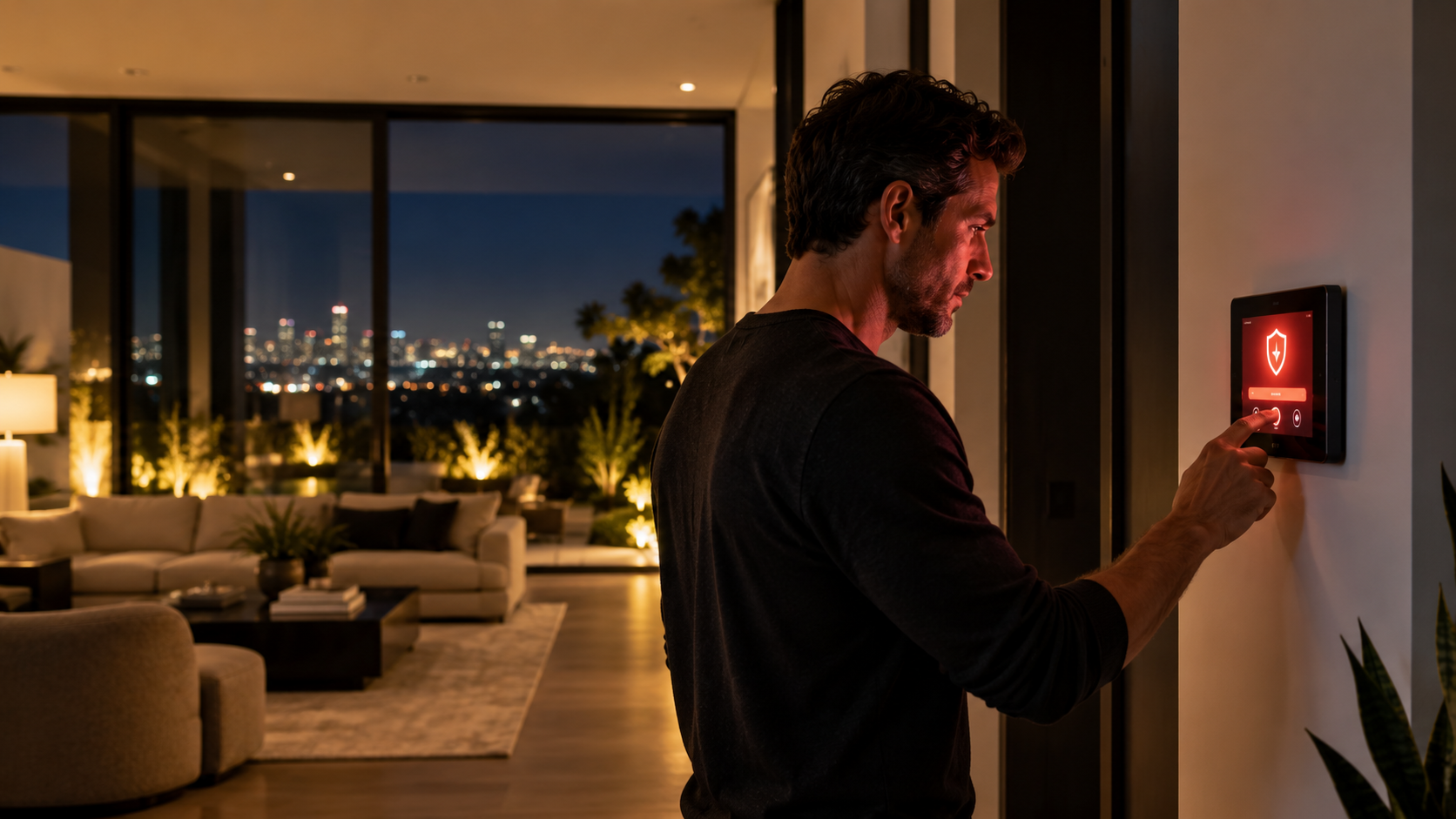
An alarm sounding inside your home is one of the most jarring moments a homeowner can experience. Most people know what the siren sounds like, but very few know what happens in the seconds and minutes that follow: who is notified, how they decide what’s real, and what determines whether police, fire, or no one at all arrives at your door. At Moore Protection, our monitoring operators handle that sequence every day for homeowners across Los Angeles. This guide walks through exactly what happens when an alarm is triggered, from the first sensor signal to dispatch and the steps that follow, so you understand how your system protects you and which decisions you make long before an alarm ever sounds.
The First Seconds: From Sensor to Signal
What Actually Trips an Alarm
Every alarm begins with a sensor detecting a change it was designed to watch for. Door and window contacts register when a protected opening separates. Motion detectors identify movement within interior zones. Glass break sensors listen for the specific acoustic signature of shattering glass. Environmental devices, including smoke, heat, carbon monoxide, and water sensors, monitor conditions that threaten the home rather than its security. A well-designed home alarm system combines these devices so that each protects a defined zone, and every zone carries an identity the system can report.
That zone identity matters more than most homeowners realize. When a sensor trips, the control panel doesn’t simply register “alarm.” It records which device activated, in which zone, and what kind of event it represents. That information travels with the signal and shapes every decision made afterward. For a broader look at how these components work together, our guide to how home security works covers the full system architecture.
Entry Delays and the Countdown
Not every sensor triggers an immediate alarm. Entry doors are typically programmed with a short entry delay, giving a household member time to walk in and disarm the system before it reports. Exit delays work in reverse, allowing time to leave after arming. Interior motion detectors are often set to follow these delays so that walking from the front door to the keypad doesn’t cause an instant activation.
These delays are configured, not fixed, and the arming mode you select changes them. A “stay” mode might arm perimeter contacts while leaving interior motion off so the family can move freely at night. An “instant” mode removes the entry delay entirely, which suits overnight hours when no one should be coming through the door. Many systems also include a brief cancel window after an alarm begins, during which entering a valid code stops the report before it reaches the monitoring center. Understanding how your modes and delays are set is one of the simplest ways to prevent accidental alarms.
How the Signal Leaves Your Home
Once the panel confirms an alarm condition, it transmits a signal to the central monitoring station. Modern systems typically communicate over cellular networks, internet connections, or both, while older installations may still rely on landlines. The strongest configurations use more than one path, so that if an internet connection fails or a phone line is cut, the signal still gets through. Cellular backup and battery reserves keep the panel communicating during power outages, which are exactly the conditions when a home is most vulnerable.
Inside the Central Monitoring Station
The Alarm Arrives
Within seconds, the signal reaches an operator’s screen at the monitoring station. Alongside the alarm itself, the operator sees the account’s details: the property address, the zone and device that triggered, the type of signal, the household’s contact list, the verification passcode, and any special instructions recorded for that property, such as a gate code for responders, a note about a dog in the yard, or a preferred callback order. Professional home security monitoring depends on this information being current, because an operator can only act as well as the account in front of them allows.
Verification: The Step That Changes Everything
For a burglary alarm, the operator’s first priority is verification: determining whether the event is genuine before requesting a police response. The most common method is a callback to the premises and then to designated contacts. When someone answers, the operator asks for the account passcode. A correct passcode with a reasonable explanation, such as a houseguest who didn’t know the code or a door left ajar, typically means the alarm is cancelled. An incorrect passcode, no answer, or a caller who seems under duress leads to dispatch.
Systems with two-way voice let the operator speak directly through the alarm panel rather than calling a phone, which saves critical time and lets them hear what’s happening inside the home. Talk-down capability takes this further, allowing operators to address someone on the property directly, which is often enough on its own to end an intrusion. These capabilities are a central part of what a professionally monitored security system provides beyond a siren.
Video Verification
Cameras have changed alarm response more than any other technology. When an alarm zone is paired with camera coverage, the operator can review live or recorded video of the area that triggered, turning an unconfirmed alarm into a confirmed event in moments. A person forcing a rear door is a fundamentally different call than a curtain moving in front of a motion sensor, and video lets the operator tell the difference. Our guide to remote home monitoring explains how video verification works alongside alerts and remote access, and strategically placed outdoor security cameras ensure the zones most likely to see real activity are the ones with visual coverage.
Video verification also changes how police treat the call. A break-in confirmed on camera is a crime in progress, not just an alarm, and agencies prioritize it accordingly. That distinction matters especially in Los Angeles, as we’ll explain below.
Why Local Monitoring Matters
The operator handling your alarm makes judgment calls under time pressure, and local knowledge improves those calls. Operators who work within the region understand the neighborhoods, the response agencies, and practical details that a distant call center may not, such as which communities have private patrol and which addresses fall under city versus county jurisdiction. Moore Protection’s monitoring is built on this principle, and we’ve written in detail about the advantages of local security monitoring for that reason.
Not All Alarms Are Handled the Same
Burglary Alarms
Burglary alarms follow the verification process described above: callback, passcode, video review where available, then dispatch if the event can’t be ruled out. Because most burglary alarms prove false, this is the alarm type where verification has the greatest impact on both response and cost.
Panic and Duress Alarms
Panic buttons and duress codes signal that someone is in immediate danger, and they are handled with urgency. Operators generally don’t attempt to cancel a panic alarm through a routine callback, because a person in danger may not be able to speak freely. A duress code, a special code that appears to disarm the system while silently signaling an emergency, exists precisely for situations where someone is forced to turn their alarm off. In the City of Los Angeles, police response to robbery and panic alarms isn’t subject to the verification requirements that apply to burglary alarms.
Fire, Smoke, and Carbon Monoxide Alarms
Life-safety alarms take a different path. When a monitored smoke detector, heat detector, or residential fire system activates, the priority shifts from verification to speed, and the monitoring center contacts the fire department quickly while also reaching the household. Carbon monoxide alarms carry similar urgency. Because the gas is invisible and odorless, occupants may not realize they’re affected, and monitored carbon monoxide detectors ensure help is requested even if no one in the home can respond. These alarms are part of a broader approach to critical condition monitoring that also covers water leaks and other hazards that threaten a home when no one is there to notice.
Trouble and Tamper Signals
Not every signal is an alarm. Trouble signals report problems with the system itself: a low battery in a wireless sensor, a loss of AC power, or a communication path that has stopped responding. Tamper signals indicate that a device’s housing has been opened or a component has been disturbed. These don’t trigger dispatch, but they deserve prompt attention, because a system with a dead sensor or a failed communication path has a gap in its protection that an intruder won’t announce. The monitoring center notifies the homeowner so the issue can be addressed before it matters.
Dispatch and Police Response in Los Angeles
When an alarm is verified as genuine, or can’t be ruled out, the operator requests a response from the appropriate agency, providing the address, the nature of the alarm, and any relevant details from the account. What happens next depends heavily on local policy, and in the City of Los Angeles, that policy has specific rules every homeowner should understand.
The City requires a permit to operate an alarm system, and operating one without a permit is a misdemeanor, according to the LAPD Alarm Section. Under LAPD’s burglar alarm dispatch policy, each location is allowed two false alarm activations within a rolling 12-month period. After that, police will not dispatch a patrol unit to a burglary alarm unless it is verified, either by someone at the location or through remote visual inspection such as video. Robbery and panic alarms are not affected by this requirement.
The reason for the policy is scale. LAPD reports responding to more than 100,000 privately installed burglar alarm calls each year, and 97% of those calls prove to be false alarms. Those calls divert patrol resources from genuine emergencies, which is why the City also assesses escalating penalties for repeat false alarms. Homeowners are billed for those responses even when the alarm company placed the dispatch request, because the police response is considered a service provided to the property.
The practical takeaway is straightforward. A home that generates frequent false alarms risks reduced police response precisely when it needs it most, while a home with video verification can provide the confirmation that elevates its alarm to a priority call. Keeping your alarm permit current and sharing the permit number with your monitoring provider also matters, and our security FAQ explains how to provide your permit to Moore Protection so it’s available when emergency services are dispatched. Homeowners outside city limits should check their own city or county ordinance, since alarm policies vary across Los Angeles County.
What You’ll Experience at Home
When You’re Home
If you’re inside when the alarm sounds, you’ll hear the siren and, within moments, likely receive a call or hear an operator through the panel. If you caused the alarm, disarm the system and give your passcode when the operator reaches you. If you didn’t, don’t investigate. Move to a safe location, keep your phone with you, and let the monitoring center and responders handle the situation. Our guide to the steps to take if your burglar alarm goes off covers this moment in detail, including how to prepare your family’s response plan in advance.
When You’re Away
If you’re away from home, you’ll typically receive an app notification as the alarm triggers, followed by a call from the monitoring center. With remote home monitoring, you can view live camera feeds, check which zone activated, and see the system’s status from your phone. That visibility lets you help the operator, whether by confirming that the movement on camera is a housekeeper who arrived early or that the figure at the back door is someone you don’t recognize. Resist the instinct to rush home and investigate yourself. If police are dispatched, let them clear the property before you go inside.
After the Alarm: Resetting, Reviewing, and Documenting
Once the event is resolved, the system needs to be reset and restored to normal operation. Most panels record which zone triggered and when, and reviewing that history is the first step in understanding what happened. If the alarm was false, identify the exact cause: a door that didn’t latch, a sensor knocked out of alignment, a balloon drifting through a motion zone, or a family member who forgot the code. LAPD’s own guidance on eliminating false alarms encourages alarm users to find out which sensor activated, determine why, and correct the cause.
If the alarm was real, preserve everything. Save and export camera footage from every relevant angle, note the event times from the system log, and document any damage before making repairs. This record supports a police report and an insurance claim, and it often reveals how an intruder approached the property, information that should shape whatever security improvements follow.
How to Prevent False Alarms
User error causes more false alarms than equipment failure, so the most effective prevention starts with people. Everyone who uses your system, including family members, housekeepers, gardeners, pet sitters, and regular guests, should know how to arm and disarm it and should have their own code. LAPD notes that errors made by relatives, housekeepers, and gardeners are not grounds for waiving false alarm fees, which makes training more than a courtesy.
Equipment configuration matters as well. Motion detectors should be selected and aimed with household pets in mind and set to sensitivity levels that match the space. Sensors near HVAC vents, windows with direct sun, or drapery that moves with airflow are common sources of nuisance alarms. Automation features need care too. Geofencing that arms and disarms based on your phone’s location can eliminate forgotten arming, but configured poorly it can create the very false alarms it was meant to prevent, as we explain in our guide to integrating home automation with security. On the exterior, perimeter security devices need to account for animals, vegetation, and weather.
Finally, test regularly. Moore Protection recommends testing your system’s communication with the central station at least once a month. A brief call to the monitoring center before you begin prevents an unnecessary dispatch, and the test confirms that the system you depend on can actually reach the people who respond.
Why the Response Matters as Much as the Alarm
A siren on its own is only part of the protection. Research on burglar behavior shows that alarm systems deter break-ins largely because of what they promise will follow: detection, response, and a real chance of being caught. We examined that research in our article on whether home security systems deter burglars. That deterrent holds only when the response is fast, accurate, and credible.
This is where monitoring, verification, and configuration come together. A system with poorly placed sensors and untrained users produces false alarms that erode police response. A system that’s well designed, properly configured, and monitored by experienced operators produces fewer false alarms and stronger responses when they count. That difference is one of the most important reasons to weigh DIY versus professional home security carefully. The equipment may look similar, but what happens after it triggers often does not.
Protecting Your Home with Expert Solutions
At Moore Protection, we believe a security system should be judged by what happens in the minutes after an alarm sounds. Our team designs and installs alarm systems with every zone, delay, and verification method configured around how your household actually lives. Our 24/7/365 monitoring center is staffed by trained operators who understand Los Angeles neighborhoods and work closely with local police, fire, and medical responders.
We also make sure you understand your own system: how your arming modes work, who has codes, how to cancel an accidental alarm, and how your permit and verification options affect police response. That preparation is what turns an alarm from a frightening noise into a coordinated response.
Contact Moore Protection today to discuss your home alarm and monitoring needs. Our security experts will review your current system, identify gaps in detection and verification, and help you build a response plan that protects your home and family when it matters most.


